
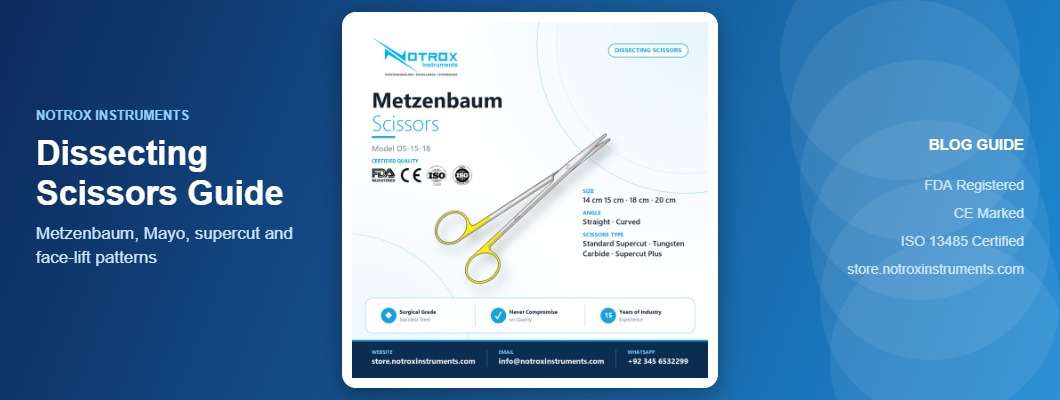
Scissors are among the most used instruments on any surgical tray, and dissecting scissors do far more than cut. Surgeons use them to spread tissue planes, undermine skin flaps, free structures from scar tissue and trim delicate layers. Choosing the right pattern, length, curve and edge makes dissection faster and safer. This guide compares the main dissecting scissor patterns used in plastic and general surgery.
Heavy Scissors vs Fine Dissecting Scissors
There are two broad families. Heavy operating scissors, such as the Mayo and Mayo Stille, have thick blades and are made to cut fascia, sutures and tough tissue. Fine dissecting scissors, such as the Metzenbaum, have long handles and short, slim blades that give precise control for delicate tissue. Using heavy scissors on delicate tissue causes crushing, and using fine scissors on fascia or sutures blunts and misaligns the blades.
The Main Patterns
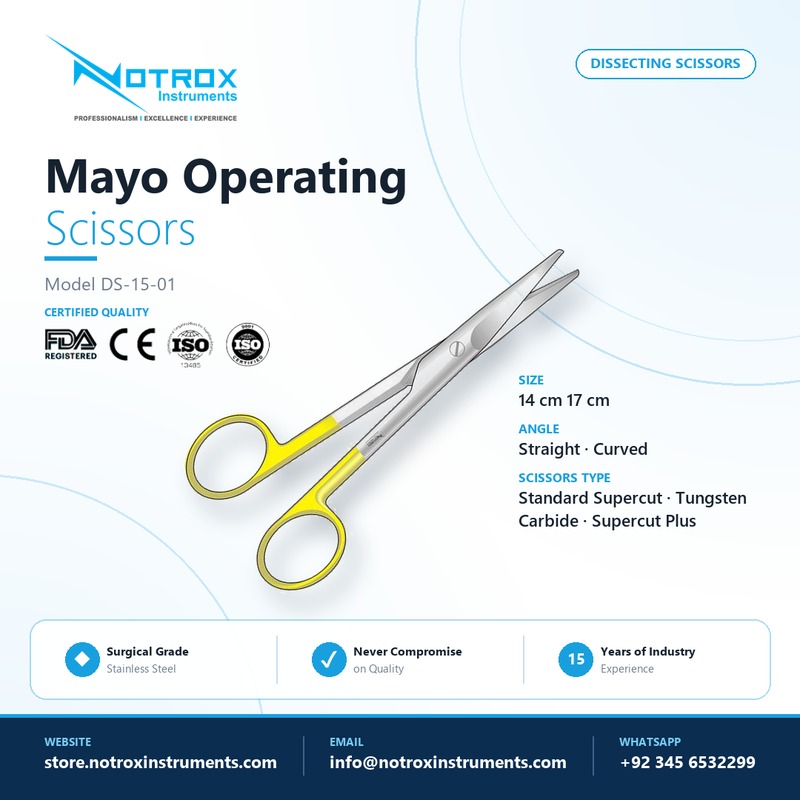
- Mayo operating scissors: strong blades for fascia and heavy tissue. Straight Mayos are traditionally kept for cutting sutures.
- Mayo Stille and Mayo Lexer: robust variations with refined blade profiles, popular in European theatres.
- Metzenbaum: the standard fine dissecting scissor, available in standard, slim, short-blade and long Nelson versions for deep work.
- Metzenbaum Freeman and Metzenbaum Fino: slimmer, more delicate Metzenbaum variants preferred in plastic surgery.
- Kelly and Toennis Adson: versatile mid-weight scissors for general dissection.
- Reynolds Jameson and Kaye: short, delicate scissors for facial and blepharoplasty work.
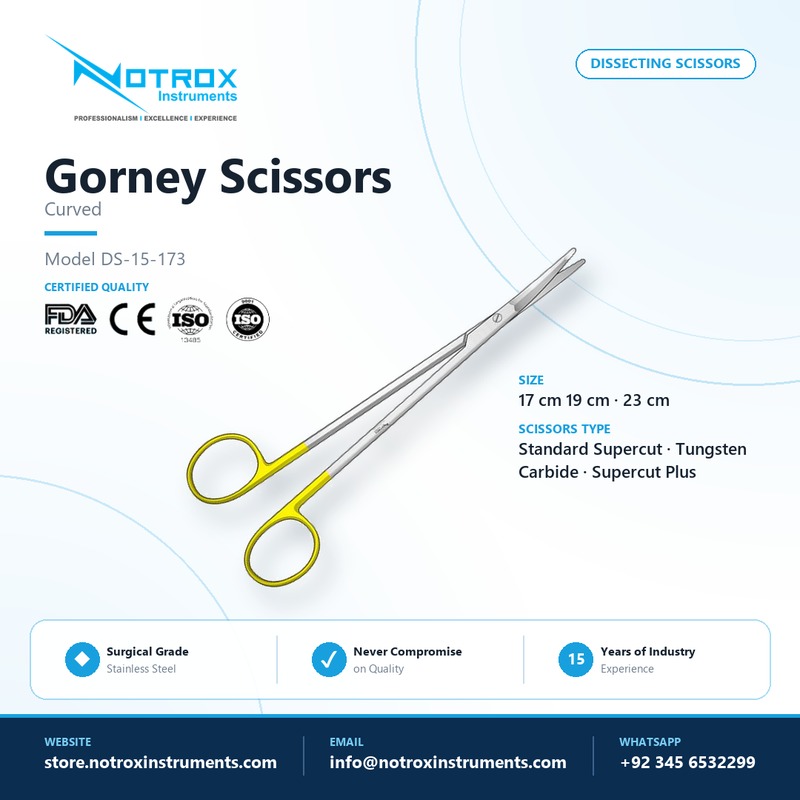
- Gorney and Gorney Freeman: curved face-lift scissors designed for undermining skin flaps.
- Fanous and Thorek: specialised dissecting patterns for controlled spreading and deep curved work.
What Supercut Means
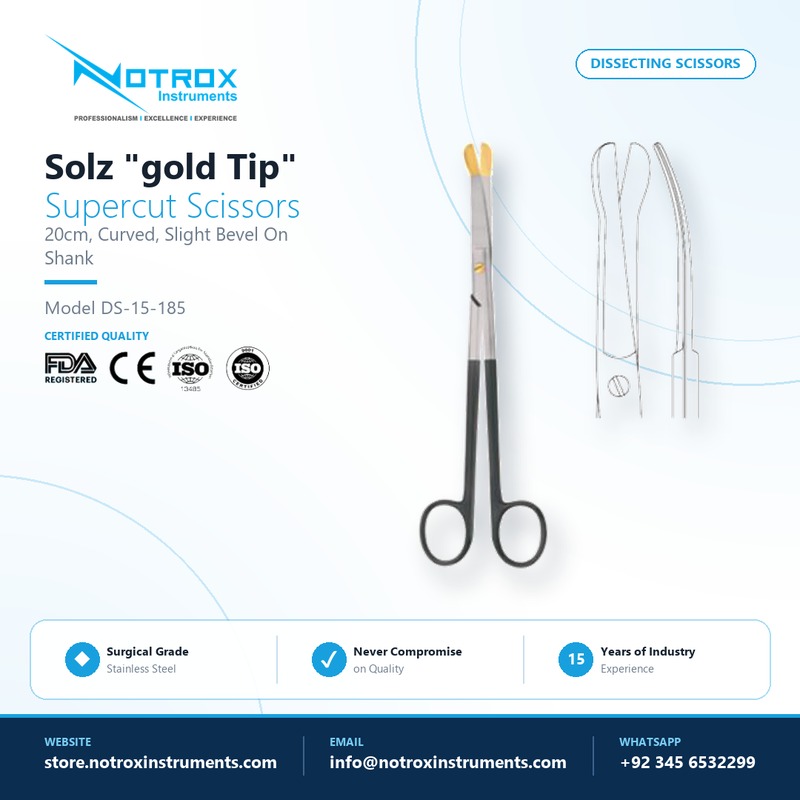
Supercut scissors have one blade ground razor sharp and the other finely serrated. The sharp blade cuts cleanly while the serrations stop tissue from slipping out of the jaws. They are usually identified by black handles. In plastic surgery, supercut blades make undermining smoother and reduce the force needed, which means less trauma to the flap. The Solz Gold Tip Supercut scissors and Metzenbaum Slim Supercut are good examples.
Straight, Curved or S-Curved?
- Straight blades are best for superficial cutting and trimming in open fields.
- Curved blades follow tissue planes and keep the tips visible, so they are the usual choice for dissection.
- S-curved blades, such as the Metzenbaum Slim S-curved or Gorney Freeman S-curved, reach around contours and deep under flaps during face lifts and abdominoplasty.
Choosing Length
For facial and hand surgery, 12 to 15 cm scissors give the most control. For breast and body contouring, 17 to 20 cm patterns reach comfortably under flaps. Deep abdominal and thoracic dissection needs 23 cm or longer, such as the Nelson Metzenbaum or the long Metzenbaum Slim Supercut.
Keeping Scissors Sharp
- Never use dissecting scissors to cut sutures, wire or dressings.
- Clean blades straight after use and dry them fully before sterilising.
- Lubricate the joint so the action stays smooth.
- Test sharpness on a test material regularly and send scissors for professional sharpening before they start to chew tissue.
See the complete range in our Dissecting Scissors category, with patterns from $10.
Why Choose Notrox Instruments
- Certified quality: FDA registered, CE marked, and ISO 13485 and ISO 9001 certified manufacturing.
- 15 years of experience: made by skilled craftsmen in Sialkot, Pakistan, with an office in the USA.
- Hand checked: every instrument is inspected for finish, alignment and function before it ships.
- Free delivery on orders over $2000.
Have a question or need a custom quote? Email [email protected] or message us on WhatsApp at +92 345 6532299. Browse the full range at store.notroxinstruments.com.