
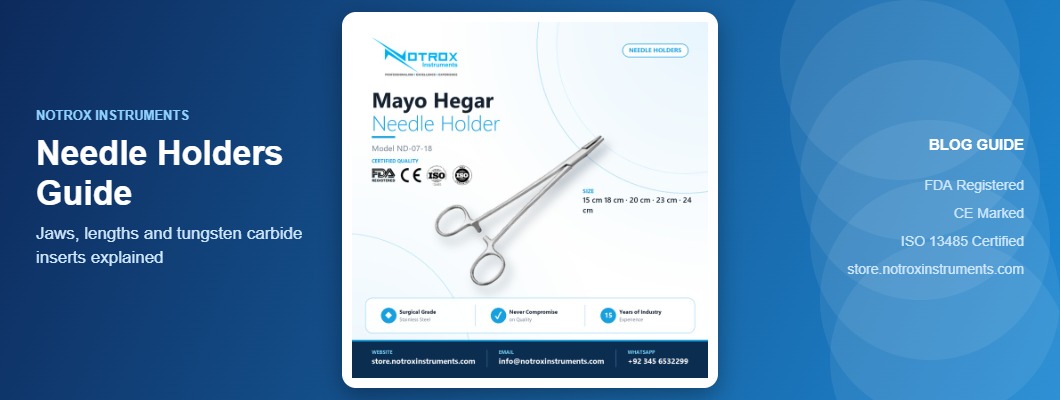
Every incision a surgeon makes has to be closed, and the quality of that closure depends heavily on one instrument: the needle holder. A good needle holder grips the needle firmly without rotating, does not damage fine suture material, and feels balanced in the hand during hundreds of throws. A poor one slips, twists the needle and tires the hand. This guide explains how to choose needle holders for plastic and general surgery, and which patterns suit which kind of work.
How a Needle Holder Works
A needle holder looks a lot like a haemostat, but it is built for a different job. The jaws are shorter and stronger, the box lock is tighter, and the ratchet holds the needle under constant pressure so that the surgeon can drive it through tissue in a controlled arc. The jaw surface is the most important detail. Serrated or cross-hatched jaws grip the needle body, while smooth jaws are kinder to very fine needles and sutures used in facial and microsurgical closure.
Standard Steel or Tungsten Carbide?
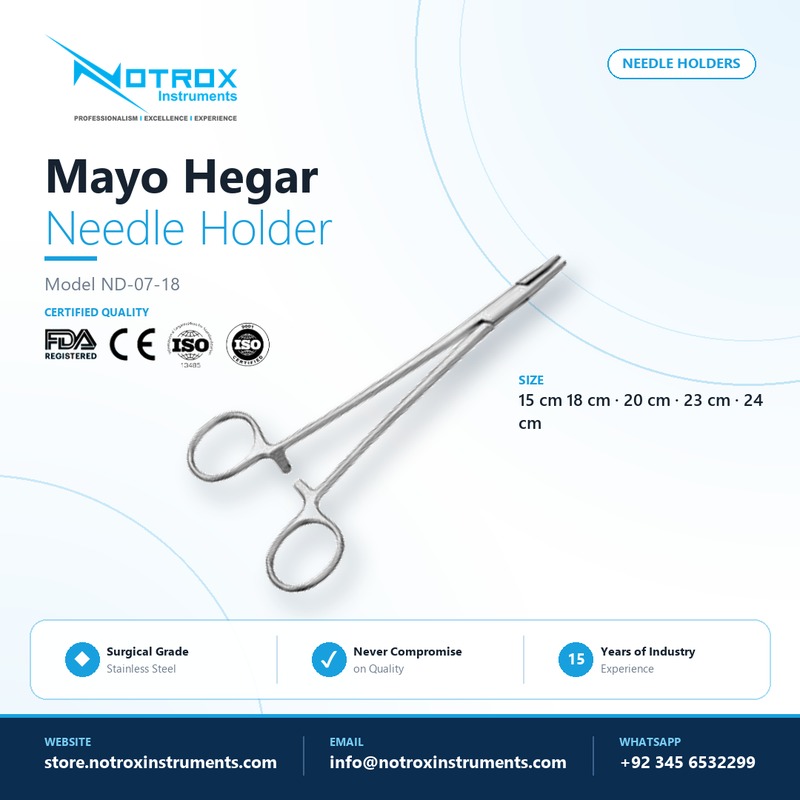
Most patterns are made in two versions. Standard stainless steel jaws are economical and perfectly suitable for routine closure. Tungsten carbide (T.C.) versions have hard inserts brazed into the jaws, usually marked by gold-coloured handles. The inserts grip the needle more securely, resist wear for far longer, and can be replaced rather than throwing away the whole instrument. For a busy theatre the T.C. version usually pays for itself within months.
- Choose standard steel for general wards, dressing trays, training sets and occasional use.
- Choose tungsten carbide for theatres where the same holder is used daily, and for fine plastic surgery closure where needle rotation is unacceptable.
Popular Patterns and Where They Fit
- Mayo Hegar: the all-round workhorse for general and plastic surgery, strong enough for heavier needles and available in many lengths. Our Mayo Hegar T.C. is a favourite for daily theatre use.
- Crile Wood: slimmer jaws than the Mayo Hegar, good for finer needles in deeper or tighter spaces.
- Halsey and Wright Derf: short, delicate holders around 12.5 to 13.5 cm for skin closure on the face and hands.
- Collier and Neivert: compact holders suited to superficial skin work and minor procedures.
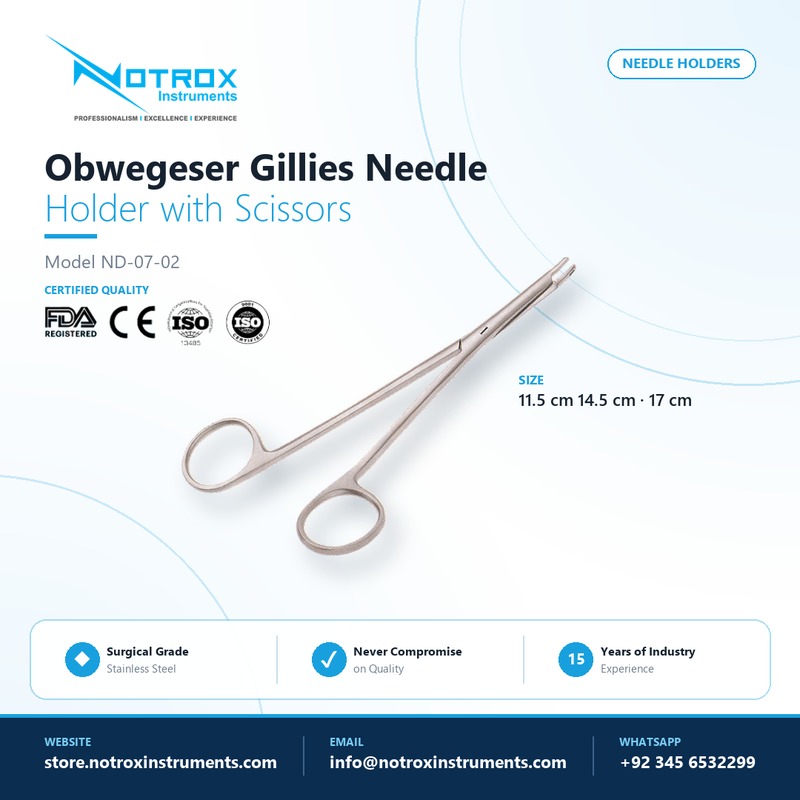
- Gillies and Obwegeser Gillies: combine a needle holder with built-in scissors, so the surgeon can tie and cut without changing instruments. Popular in plastic and facial surgery.
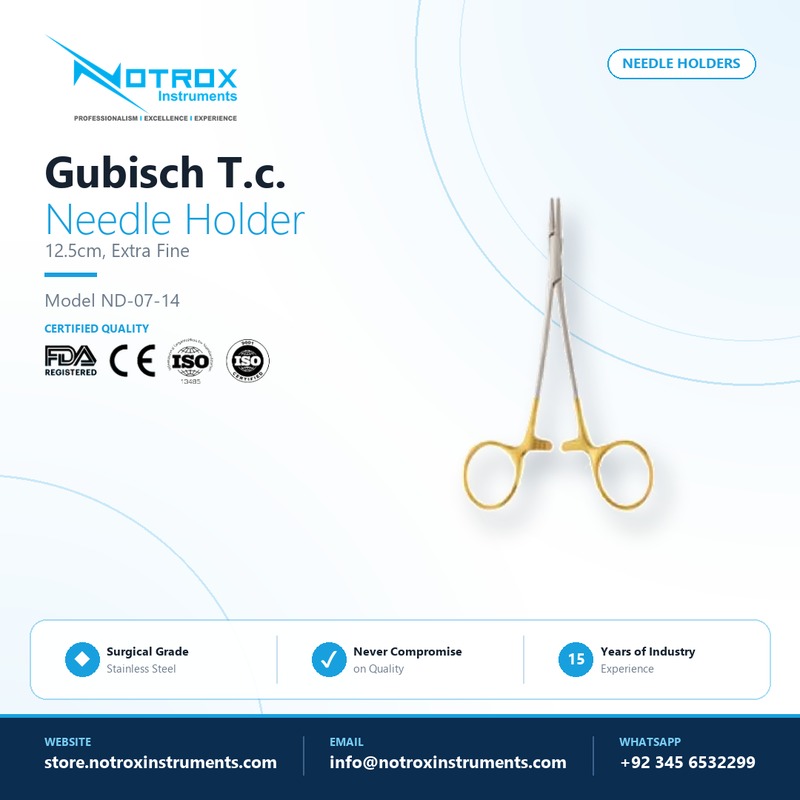
- Gubisch T.C. extra fine: very fine jaws for delicate sutures in rhinoplasty and eyelid work.
- Senning and Mathieu: extra delicate and ratchet-handled patterns respectively, used for fine vascular and paediatric work.
- Cottle Masing: a delicate holder with smooth jaws, used in nasal surgery where fine sutures must not fray.
- Bozemann Wertheim and Thomson Walker: long, S-shaped holders for deep pelvic and gynaecological closure.
Matching Length to the Procedure
Length matters as much as jaw type. Shorter holders of 12 to 14 cm give the best control for superficial skin closure, especially on the face. Mid-length holders of 15 to 18 cm suit general soft-tissue closure and breast or abdominal work. Long holders of 20 cm and above are needed in deep cavities. A practical plastic surgery tray usually carries at least one short fine holder, one mid-length Mayo Hegar or Crile Wood, and one combined holder with scissors.
Matching the Holder to the Needle
- Use fine, smooth or extra fine T.C. jaws for 5-0 to 7-0 sutures.
- Use standard serrated or T.C. jaws for 2-0 to 4-0 sutures.
- Avoid gripping fine needles with heavy jaws: it flattens or bends the needle and weakens the closure.
- Grip the needle about one third of the way back from the swage, never on the swage itself.
Care and Maintenance
Clean needle holders immediately after use so that blood does not dry in the box lock or the jaw serrations. Open the ratchet before sterilising, use a soft brush on the jaws, and lubricate the joint with instrument milk regularly. Check the jaws against the light: if you can see gaps along the length when closed, or if the needle rotates under light pressure, the holder needs repair or, for T.C. versions, new inserts.
Browse the full range in our Needle Holders category, with standard steel patterns from $19.50 and tungsten carbide holders from $45.
Why Choose Notrox Instruments
- Certified quality: FDA registered, CE marked, and ISO 13485 and ISO 9001 certified manufacturing.
- 15 years of experience: made by skilled craftsmen in Sialkot, Pakistan, with an office in the USA.
- Hand checked: every instrument is inspected for finish, alignment and function before it ships.
- Free delivery on orders over $2000.
Have a question or need a custom quote? Email [email protected] or message us on WhatsApp at +92 345 6532299. Browse the full range at store.notroxinstruments.com.